Road on China-Europe trade route expanded in Karakalpakstan
After reconstruction, the 25-kilometer section of the highway between Nukus and Urgench will be able to handle twice as many vehicles
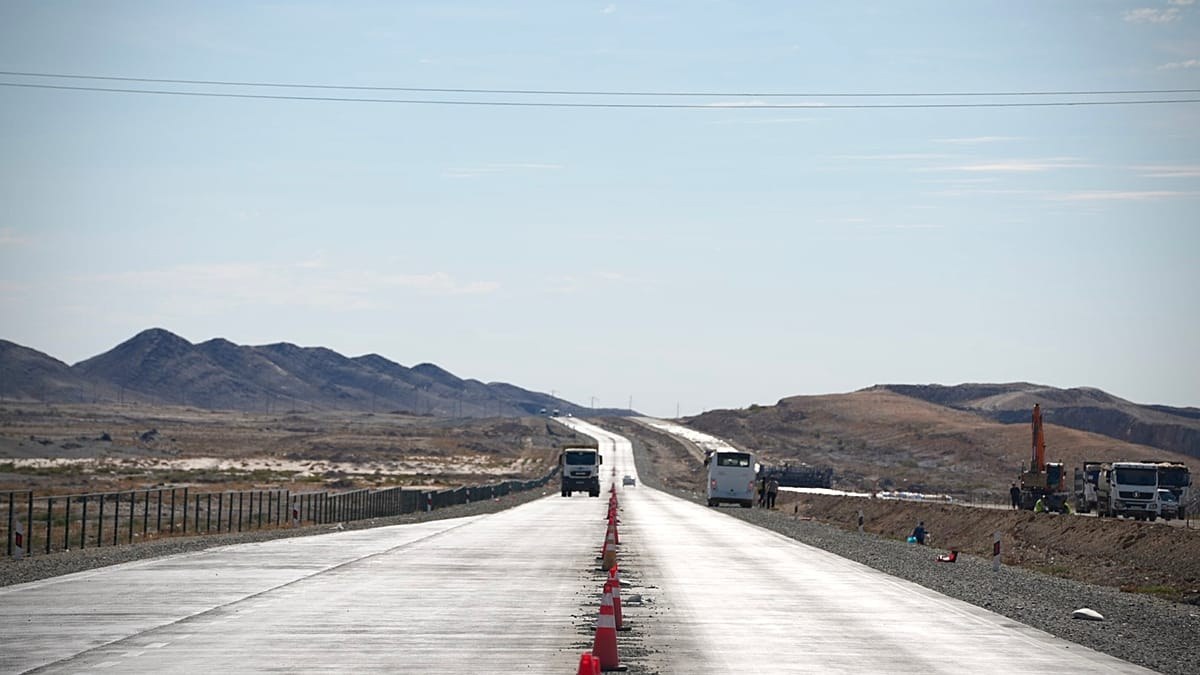
In Karakalpakstan, around 90% of the work to expand the A380 highway section between Nukus and Urgench has already been completed. The $48.7 million project aims to increase the road's capacity, which is part of the trade route between China and Western markets, including Europe.
According to Bakhodir Boltaboev, Deputy Director of the Asian Development Bank's (ADB) Project Implementation Group, about three kilometers of concrete pavement remain to be laid, and the construction of an overpass needs to be completed. The section will also feature separate turnaround ramps to prevent vehicles from crossing oncoming lanes.
After reconstruction, daily traffic is expected to rise from 6,000–7,000 to 14,000–15,000 vehicles.
Another 240-kilometer section of the A380, from Kungrad toward the border with Kazakhstan, was completed in 2024. Carriers report that reconstruction has reduced travel time and truck maintenance costs.
Damir Mamutov, General Director of the transport company Promizvest Servis, who has been involved in international transportation for about 15 years, said that trucks previously took at least 10–12 hours to cover the 240–250 kilometers between Kungrad and Beineu. Now, the trip takes three to four hours. Before, trucks often required tire and suspension repairs after just one or two trips; such cases have become less frequent since the reconstruction.
The expansion of the A380 is part of a broader road development program supported by the ADB. Its budget amounts to $383.4 million: $274.2 million will be provided by the bank in the form of loans, and another $109.2 million by the government of Uzbekistan.
The highway is part of Corridor 2 of the Central Asia Regional Economic Cooperation (CAREC) program, which unites 11 countries. Its goal is to develop transport infrastructure, simplify trade, and strengthen economic cooperation.
Begzod Jalilov, ADB Regional Cooperation Specialist, noted that economic corridors require investments not only in roads but also in tourism, agriculture, and the service sector. According to him, this should contribute to job creation, increased population income, and expanded export opportunities.
However, road conditions are not the only factor affecting transportation speed. Customs procedures and delays at international borders can still slow down cargo movement.
Jalilov reported that, in parallel with road infrastructure development, the ADB and its partners are working on modernizing border crossing points. Plans include digitizing procedures and implementing electronic queuing systems for trucks.
In August 2026, the ADB approved a separate regional financing mechanism worth $400 million called Border Upgrades for Integration, Logistics, and Development (BUILD). The funds will be directed toward modernizing road and rail border crossing points in CAREC countries, including digital systems, inspection equipment, and improved border management.